Saturday, August 07, 2010

The Spirit of Exploration

(Note:  Please forgive today’s fragmented post.  If I were a writer, I would take more time to edit and refine my words.  Obviously, I’m not a writer.) 

When I was a kid, I loved to explore.   That simple desire opened the floodgates of my imagination.  As a child, I trekked across Antarctica in my dog sled.  I journeyed to distant planets as an astronaut.  I searched magical woods, surveyed the ocean floor, and reached the peaks of the highest mountains, all without leaving my own back yard.   As I grew older, my desire to explore continued, but extended beyond my own home.  I lived in a rural, farming town and had the opportunity to explore mountains and forests.  I discovered wonderful things like tadpoles in shallow lakes that formed when the snows melted and lasted only a few short weeks.  I walked the hills looking for arrow heads left behind by Native Americans.  I drove along winding dirt roads, just to know where they went.  Today, that sense of exploration continues, but it has evolved.  I find myself exploring ideas, concepts, and thoughts.  I ask “what if?”  I draw, paint, write, and then try to share my explorations with others.

At the root of exploration is Curiosity.  It’s a desire to know what is “out there.”  Children are naturally very curious, but their ability to explore is restricted by parental impatience, age, ability, and fear.  As children grow into adulthood, some stay curious, but many of lose their desire to explore.  Exploration is risky.  And when you have bills to pay, you shy away from risk.  You stifle your curiosity.  You settle into routine.  You become concerned with comforts.  You worry about entitlements.  You work hard for your home, your cars, and your flat screen televisions and that is good enough. 
That scares me.
And it’s an attitude that’s becoming more prominent in our culture.  For example, when I was in elementary school, astronauts were honored and shuttle launches were broadcast, but today, we no longer value space exploration as we did in the 50s, 60s, 70s, and 80s.  Why?  Because many think it is frivolous to spend money on exploration, on curiosity.  Not to mention, space exploration is risky.  People can die.  But when did Americans become afraid to take risks?     Risk-taking is vital to innovation and creativity.  when we take risks, we’re bound to make some mistakes, but we’re also going to discover some revolutionary advancements along the way.
Have you noticed we now live in a world where “standard” is considered good?  We require “standard” in our education systems.  We are pushing “standard” in health care.  We set “standards” for near everything.  But if you look up “standard” in the dictionary you’ll find a lot of words like “average”, “common”, and “normal."  And, with regard to the beef industry, “standard” is one step down from “good.”   Now, I agree that there is some nobility in trying to make sure everyone reaches a certain “standard”, but it can only be done by pulling down or taking away from those above said standard.  Standards restrict the spirit of exploration.  They limit creativity, and should be used sparingly.
I believe that compulsory standards may help a few, but overall they have a detrimental effect on the advancement of civilizations and the human race.  I don't believe that government intervention is needed to fix all (or even most) of our problems.  What we need is innovation (builders building what dreamers dream).  We need people willing to take risks in order to solve problems.   
As an artist and educator, I worry that we are robbing future generations of the magic of exploration.  We are teaching them it’s wrong to be curious.  We are pulling down creativity and innovation.  And we are left with nothing but “standard” answers where “exceptional” solutions are needed.

Friday, July 09, 2010

Quick, find me some wood to knock on.

Dare I say it?  The past year has been a pretty amazing year.  I don't mean that it has been free of problems.  It hasn't.  In fact, if I wasn't so overwhelmed  by the good things, I might complain that this has been one of the most difficult years of my life.  Instead, I'm thrilled to be employed as a teacher at DaVinci Academy,  I'm overjoyed that Julie Wright and I have found a supportive and visionary publisher for The Hazzardous Universe, and I'm very optimistic about several other projects currently in development.  Not to mention, there have been a number of wonderful experiences in my personal and family life, most of them too personal to share here. I feel a sense of gratitude, but also a little fear.  I worry that my "15 minutes" will expire soon.  So, I'm knocking on wood, hoping for continued satisfaction and success.  I'm hoping that it's true that a little talent and lot of perspiration will go a long way.

As I mentioned, The Hazzardous Universe now has a publisher.  If you would like to know more about our experience of finding a publisher, I suggest you read Julie's blog.  I was going to write about it, but I'm an artist and she's a writer . . . she has already said it all more eloquently than I ever could. 

Saturday, June 26, 2010

Thoughts on Measuring Creativity in a Historical Context

Can the creativity of historical artists be measured? Obviously, that's been on my mind this past week.  The "Michelangelo-vs-Van-Gogh" discussion gave me a few ideas.  For instance, if we define creativity as "the ability to organize raw materials and undeveloped ideas into new and meaningful products", then perhaps we can find a way to measure a "product's" creative value in terms of how new (novel, original) and meaningful (enduring, influential) it is.  Perhaps we could assign a qualitative number (from 1 to 10) to each of these categories, multiply them, and arrive at a quotient between 1 and 100 (the higher the number, the greater the creativity of the product). In that way we could assign a value  to the creativity of a product.  For example, let's consider Vincent Van Gogh's painting, "Starry Night."  How does it rank with regard to newness?  Well, Van Gogh was influenced by Japanese woodblock prints, and he associated with several notable artists of his time, yet his work was highly original.  In fact, Van Gogh's art was never well received during his life time, which, arguably is a testament to it's uniqueness.  It often takes time for the populace to accept new ideas.  This was the case with Van Gogh, so let's give him a 9 for newness.  And how about meaningfulness?  Well, this Starry Night was created in 1889, so it has endured only a short period in the history of art, but since then it has become one of the most popular images of all time.  It's young, but has connected with a lot of people, so let's give it an 8.  So, 9 x 8 gives us a quotient of 72.  What do you think?  What works of art might receive a 100?

In addition to analyzing the creativity of a product, we would also want to consider the creativity of an individual.  Is there such thing as a "creativity quotient"?  What designates a person as creative?  And what makes one person more creative than others?  If we identify those traits, then perhaps they could be measured independently and help arrive at a quotient.  We might consider the quantity of products that an individual creates during his/her lifetime, the average quality of those products, and the breadth of that person's creativity achievements (i.e. DaVinci's interest in art, science, engineering, etc.).  What other measurable traits might be considered?

I should probably explain my current obsession with creativometry (did I just coin a new word and does it work?).  As I mentioned in my last post, I teach a class called History of Art and Science, and at the root of that class is creativity.  And as I have taught that class, it has become quite obvious that--although I believe we're all born with it--not every individual develops creativity in the same way or to the same extent.  I don't necessarily believe that creativity can truly be measured, however I would like to give my students some sort of tool they can use to compare and contrast creative individuals, products, and periods throughout history.  So, I hope you'll let me know what you think of these ideas.  Thanks.

BUY IT:  Starry Night, c. 1889 Art Styles Poster Print by Vincent van Gogh, 36x24

Sunday, June 20, 2010

Who is more creative, Michelangelo or Vincent Van Gogh?

Let me begin by way of confession: I used to hate studying history.   In college, it was torture for me to sit through American History.  Even my Art History classes pushed me to the edge of human endurance.  Ironically, this past year I was asked to teach a unique class at DaVinci Academy called The History of Art and Science.  I was intimidated.  How could I teach the very subject I so greatly disliked?    But, as I considered the class, I soon realized that, at it's core, it was nothing more than the history of creativity . . . and, as many of my family and friends know, I like to talk about creativity . . . a lot.  I fully agree with Sir Ken Robinson when he writes, "The highest form of intelligence is thinking creatively."  And now I had the chance to teach my students to be creative through analysis of history's greatest cultures and individuals.  I found a reason to enjoy history, and my obsession for creativity gave it meaning.  I think overall, my first year of teaching the class was successful, but I feel I only scratched the surface of the class's potential.  I'm reading a lot, hoping to expand the class's concepts, but I would like to also get some input from others . . . yeah, by "others" I mean you.  I want to know what you think.  In particular, I would like to bounce around some ideas and questions and get your feedback. So let's start with these:

Who is more creative, an artist like Michelangelo, whose greatest works were commissioned by the Catholic church, or an artist like Van Gogh, whose art was inspired only by his own observations and imagination?  How do we define and measure creativity in a way that lets us compare these artists?  What system of metrics can we use?

 There you go.  Please, leave your comments below and help start a discussion.  Thanks.

Book Recommendation:  The Element: How Finding Your Passion Changes Everything  by Sir Ken Robinson

"Serenity" Prints Available

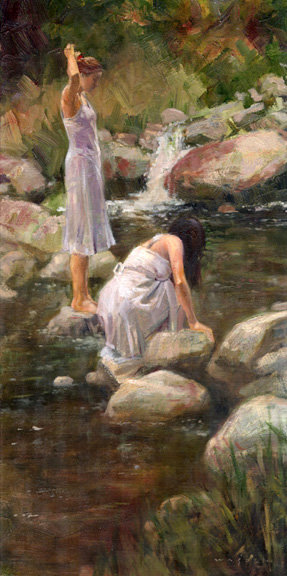
Giclee Prints (signed and numbered, limited edition of 50) are available of my painting, "Serenity."  These prints are 15" x 30" on canvas.  They are amazing reproductions of the original painting.  Price is $125 plus shipping & handling.  Please contact me via the email link in my blog profile.  Thanks.

 For you Ogden locals, I have my prints made through Fine Arts Gallery on 25th Street.